Horses vs. Camels: What Are the Differences and Their Uses?

Horses vs. Camels: What Are the Differences and Their Uses?

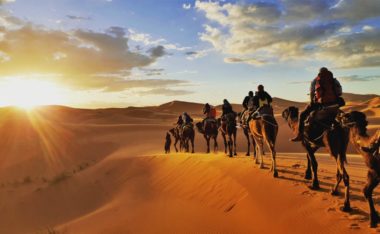
Here are the differences between horses and camels and their different uses: Their primary differences are: Speed Digestion Tolerance to the harsh desert climate Spitting Eyelashes and the third eyelid Sleeping habit  Life span Structure of the foot  Number and structure of mammary glands and teats The direction of penis and urination  Their uses differ primarily in: Riding, racing, and shows Transportation Meat Milk Beauty products and soaps Hair Leather If you want to learn all about the differences between horses and camels and how their uses differ, then you’re in the right place. Let’s get started! Differences Between Horses and Camels and Their Different Uses? I can make a General in 5 minutes, but a good horse is hard to replace. Abraham Lincoln This quote from Lincoln testifies to the glory of horses and their service to mankind for centuries. Before the age of fighter jets or Mercedes trucks, horses served as key military equipment. Horses are a symbol of strength, power, speed, and pride. They are one of the most loyal domesticated animals.  Although the use and purpose of keeping horses have changed over time, today’s horses still serve humans through sports competitions, recreation, and even transportation in some developing countries.  A horse is an entity used for expensive sports like equestrian (horse riding) shows and polo matches to the cheapest mode of transportation in poorer countries.  On the other hand, camels are not exactly slouched in this arena. Often found in the stretches of deserts such as in the Middle East and Africa, the camel—also known as the “ship of the desert”—is well adapted to survive the harsh desert climate. Camels can perform well in places where horses may not be a great option. What Are the Comparative Human Uses of Horses and Camels? Both camels and horses have been used in the past for similar purposes but in different environments.  In this section, we will be discussing the comparative efficacy of both horse and camel for different activities and services to human beings.  #1 Riding, Racing, and Shows There are dozens of events involving horse racing worldwide, such as flat racing, harness racing, jump racing, steeplechase, and endurance riding in many regions worldwide.   Many different equestrian sports are played worldwide under the International Federation for Equestrian Sports platform, with slight cultural modifications for different cultures. These sports include: Polo Coleo in South America Doma Vaquera in Spain Tent-pegging in Pakistan and India There are dozens of international horse shows conducted worldwide each year, such as the London International Horse Show and AQHA World Championship.   Although less popular than horses, camel racing has also been very popular for ages. Many camel-racing events occur legally or illegally in the Middle East, UAE, Sudan, and Indian subcontinent.  The camel race with the biggest prize money in Australia has a prize purse of 500,000 Australian dollars. The Sheikh Zayed International Camel Endurance Race and Boulia Desert Sand Race are conducted in Queensland, Australia.  Believe it or not, there are camel shows as well. One of the biggest camel shows and fairs is conducted in Rajasthan, India.  #2 Transportation Humans have used horses and camels almost equally and effectively for carriage and transportation. Both species have been used to carry the troops, weapons, goods for trade, and pull carts and trolleys.  A horse can carry 20% of its body weight safely. On average a horse weighs 880 lbs (400 kg). So it can carry 176 lbs (80 kg) safely. The table below shows the different weights of horses based on their types. Horse Type Horse Weight Draft 1,500–2,200 lbs (680–998 kg) Light 800–1,500 lbs (363–680 kg) Ponies 300–900 lbs (136–408 kg) Miniature 100–350 lbs (45–159 kg) The maximum weight a horse can carry is about 400 lbs (181 kg). Even today, horses and mules (a cross between a mare and donkey) carry military equipment in hilly areas.  A camel can carry more weight than a horse, up to 600 lbs (272 kg), and is more trusted in deserts and unstable terrains.  It can walk for longer distances without food and water and is more successful in the huge stretches of deserts in the Middle East, Africa, Pakistan, and India. So, as far as transportation is concerned, the camel is more successful in this area than the horse.  #3 Meat In human history, horse meat has been used extensively for food during drought, wars, and even on cultural and religious events. Horse meat is as nutritious as beef and has a slightly sweeter taste due to the high glycogen in horse meat.  The color of horse meat is red and contains 21 g of protein, 3 g of fat, and has fewer calories than lean beef—108 kcal per 3.5 oz. (100 g) compared to 120 kcal per 3.5 oz. (100 g). The horse meat contains more iron and many other minerals and has slightly more protein than beef. There are some cultural and religious promotions as well as hurdles in regards to consuming horse meat. In countries like Pakistan, India, and Afghanistan, horse meat is not consumed except illegally.  However, China is the largest producer of horse meat, followed by central Asia and other countries. Horse meat can be difficult to chew, especially in the case of meat from older horses.  Over 1 million horses are slaughtered each year for meat, and most of them include: Ex-racehorses Sick or injured horses Older horses.  Camel meat has been extensively used throughout history. With a good moisture content of 76–78%, a protein content of 20 g and fat content of 6 g per 3.5 oz. (100 g), and a high concentration of minerals and vitamins, camel meat is very popular in many communities around the world. Camel meat contains around 136 kcal per 3.5 oz. (100 g). The table below shows the comparison of the nutritional contents of different meat products per 3.5 oz. (100 g) serving. Type of Meat Calories Proteins Fats Horse Meat 108 kcal 20.6 g 2.6 g Lean Beef …

Read more

Horses Sitting: Can a Horse Sit? (They Can't Sit—Here's Why)

Horses Sitting: Can a Horse Sit?

Here’s whether horses sit: Horses can’t “sit down,” but they can “sit up” after they rise from lying down. The duration of this “sit-up” position can be improved with training. Anyway, this behavior is neither natural nor essential for horses. If you want to learn all about why horses can’t sit and why that is so, then you’re in the right place. Keep reading! Do Horses Sit? Horses don’t sit. Believe it or not, horses actually can’t “sit” as we do. Let’s learn a bit more about horses to see why: Do Horses Need To Sleep? Obviously, the answer is yes. All creatures need to rest or sleep. Yet, how do horses do it? Let’s explore that question.  The scene of a rider seated on a saddle and enjoying the sitting trot is common to most of us. But sleep is a vitally important necessity of any living being, and horses are no exception.  After hours of physical exertion, a horse is in dire need of rest. The consequences of sleep deprivation can be disastrous for a horse.  A sleep-deprived horse can become emaciated, and its ability to control its body is severely curtailed. The animal’s metabolism is also disturbed, and it can lose weight despite more feed intake.  During the deepest phase of sleep, the brain develops the animal’s long-term memory. It is also when much of the nutrients it consumed are absorbed into the blood. Hence, sleep deprivation can have a negative impact on the memory, learning, and overall well-being of the animal.  So, it is clear that horses need sleep. But, their sleep is different from ours. Is Horses’ Sleep Different From Humans’ Sleep? So, what’s unique about the sleep of a horse?  The Duration The sleep pattern of an adult horse is quite different from humans. While humans require at least eight hours of daily sleep, an adult horse sleeps for only three hours every day—the sleep pattern of a horse changes with age.  A young foal may sleep for as much as twelve hours a day until about three months of age. As they move towards adulthood, they reduce the number of naps and prefer to rest in an upright position.  Sleeping Behavior  The horses also use a buddy system when sleeping. In this system, one group member allows others to sleep while he himself acts as a watch.  The watch-horse position is rotated among the group. This is an evolutionary adaptation because the horses are prey animals in natural ecosystems and are continuously faced with threats. Although many are now domesticated, they still retain the natural instincts of wild horses.  The Position It is a well-known fact that horses sleep while standing. The details of that phenomenon are discussed below: Don’t Horses Need To Sit Or Lie Down for Sleep? Now, let’s come to our main point. Can our equine friends sit or lie flat on the ground as we do to sleep?  The answer lies in the unique anatomy of a horse’s legs. The horse is blessed with a unique group of core muscles, tendons, and ligaments which “lock” various joints in the hip region of both fore and hind legs.  This arrangement allows a mare or stallion to enjoy the light phase of its sleep without sitting or lying down. This feature is very useful for the horse because it allows it to ward off muscular fatigue without collapsing to the ground. How Does the Joint Locking Work? This “stay apparatus” allows the muscular giant to enjoy the sleep in a standing position with virtually no muscular activity.  The animal shifts its entire body weight on the three legs, allowing the fourth to rest in a flexed state with almost no weight on it.  The animal shifts the weight periodically to rest a different leg each time. The horses play with this apparatus by shifting their hip and locking the patella bone into position afterward.  In this way, a horse can reduce the muscular fatigue of each leg without lying flat. So this “stay apparatus” is very helpful for large mammals.  In the absence of this apparatus, an animal may never handle the fatigue incurred during its running activities.   What Is the REM Phase of a Horse’s Sleep? Is this standing-while-sleeping sufficient for a horse?  Although they can get rid of fatigue while in a standing position, they also have to lie down for the rapid eye movement (REM) sleep phase.  During this phase of deep sleep, a horse relaxes its muscles completely. The length of this phase is only 30-40 minutes in 24 hours and is usually accomplished in phases of variable length. But horses don’t have to sit to lie flat on earth to sleep. Why Is Sitting Down Impossible for a Horse? It’s quite a surprising fact that the strongly muscular legs of horses can’t help it to sit down as a dog or cat does. Why?  The bending of its legs is an anatomical impossibility for the horse. The upper body of a horse is quite massive, while their legs, although strongly built, are relatively thin.  So, if the animal tries to bend its hind legs, its own huge weight could result in the animal crashing down onto the ground with the risk of severe and life-threatening injuries.  Moreover, the digestive anatomy of the horse is such that the weight of the horse will be placed on its digestive tract in the sitting position. So, the sitting position of a horse can lead to digestive issues, such as disrupting the flow of blood towards the digestive system leading to the development of excessive gas pressure and colic. Hence, resting in a standing position is a better option.  This evolutionary adaptation is very advantageous for them in the wild because their ancestors continuously faced threats from their natural predators.  So, they had to be ready to respond quickly to any predator threat and run away. So by sleeping in a standing position, the horse will be able to …

Read more

Why Don't Humans Milk Horses? (+ Interesting Facts)

Why Don’t Humans Milk Horses?

This is whether or not human milk horses, and if not, why that’s the case. In short: Horses were not bred to be used for milk production. So if you want to know all about milking horses, then you’re in the right place. Let’s get started! Do Humans Milk Horses? Who says that humans don’t milk mares? (Mare means a female horse.) Actually, we do.  Did you know that humans have been milking mares for centuries and still do?  Here are some examples: Cleopatra, the ancient Egyptian Queen, would take baths in donkey milk to preserve her beauty. Even today, mare’s and donkey milk is considered excellent for human skin and are often found in many beauty products. In Europe, horse milk, even today, is used mostly for cosmetic purposes. As far as drinking is concerned, horse milk is consumed in central Asia, Russia, Tibet, and some parts of China. Although Europeans are less inclined to drink mare milk, some do. There is a variation of mare’s milk that is sold to drink in France. In ancient times, donkey milk was used to feed orphan kids and to treat many skin and liver illnesses. A fermented mare’s milk product called Kumis is made and drunk by nomadic Mongolians in central Asia.  Although horse milk is healthful and tastes good, horse milk is not an economically viable food option for humans because it is expensive to produce, less nutritious, and not easily available.  Horses were not bred to be used for milk production To advance our discussion on mare’s milk consumption, let us first discuss the composition of mare’s milk so we can answer the age-old question if horse milk is similar to that of human breast milk. What Is in Horse Milk? Milk is milk, right? Well, not necessarily. Let’s see what horse milk contains. Composition and Comparison With Human Breast Milk A lot of literature says that the composition of mare’s milk is similar to that of humans. The main differences include the amounts of fat, lactose, and proteins, especially the protein casein.  With the total amount of solid contents coming in at about 10-11%, horse milk is thin and contains more water than human breast milk, cow’s milk, goat milk, or sheep (ewe’s) milk. It also contains much less fat.  However, it does contain much more protein and calcium. The lactose— that is, the sugar in milk—is in almost comparable concentration. Normal values of different nutrients in mare’s and human milk are listed below.  Nutrient/Mineral Mare’s (female horse) Milk Human Breast Milk Fat (gram/kg) 12.1 gram 36.4 gram Protein (gram/kg) 21.4 gram 14.2 gram Lactose (gram/kg) 63 gram 67 gram Casein (gram/kg) 10 gram 3.7 gram Calcium (mg/100ml) 102 mg 30 mg Magnesium (mg/100 ml) 9 mg 3 mg Not An Exact Copy, But Could It Be a Substitute for Human Breast Milk? As the facts show, we cannot say that horse milk is an exact copy of human breast milk. If it was, it would be used as a replacement for human breast milk to supplement breastfeeding.  Could it be used for that purpose anyway? We have to remember that the difference in the composition is due to the fact that mammals produce milk for their young. The young of each species have different nutritional needs.  Yet, it is clear that horse milk can be consumed by humans and is consumed in many different regions of the world.  Then, why is it not popular or readily available at the grocery store? Does it have a bad taste? No, of course not. Although mare’s milk is thinner than human or cow’s milk due to its low fat, it is drinkable and doesn’t have a bad taste or smell. It is sweeter than cow’s milk and tastes like diluted cow’s milk with a touch of almond flavor. I would say that taste is not the issue. Even some people don’t like the taste of cow’s milk. Then, what’s the reason why mare’s milk is not consumed equally to other milks made by other mammalian species?  Why Do We Not All Drink Mare’s Milk? The answer lies in the following factors: Low Production As you know, the sole purpose of a breeding mare is to nourish a neonate (baby mammal, in this case, a horse) to make it a healthy horse. Horses today are now kept and bred for racing, beauty shows, and aesthetic preferences. In all these cases, milk production is a secondary, or I would say, a tertiary trait to look for.  The average milk yield of a mare is 11.6-23.3 qt./day (11-22 liter/day), which is less than that of the smallest cow breed. It is also important to note that the milk yield of the mare is not enough to fulfill all the necessary requirements of its own foal after it gets older than 2 months.  While nutritionally important early on, foals eat more solid foods and consume less mare’s milk after two months. Moreover, some horse owners don’t milk mares to keep the calf optimally growing.  Here arises an important question:  “Why don’t we improve the horse breeds for milk production?” The answer is we do. Continuous efforts are being made to improve equine milk production, and the industry is reviving, but still, the main purpose of the breeding mare is to produce healthy foals to make good horses. Low Nutritional Value Despite the many health benefits, well-known history of feeding human infants animal milk as a substitute for human breast milk, horse milk just doesn’t measure up.  Mare’s milk has more water when compared to cow’s milk and therefore provides less fat, proteins, and other important nutrients. Therefore, the nutritive value of horse milk is far less than that of milk from cows, buffalos, camels, sheep, goats, and even humans. The Purpose of a Mare Is To Produce Healthy Foals, Not Produce Milk Would you cook food in your brand new Mercedes? Of course not. That’s not its purpose. Likewise, horses were never intended or …

Read more

Lion vs. Hyena: Who Wins in a Fight? (+ Vital Facts)

Lion vs. Hyena: Who Wins in a Fight?

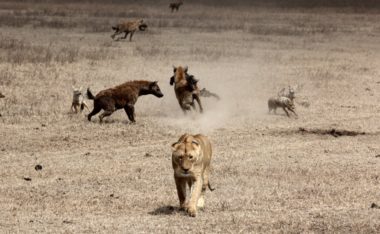
Here’s who wins in a fight between a lion and a hyena. Because hyenas have neither the speed nor the agility of a tiger nor the size and strength of the elephant, a hyena stands little chance against a lion in a one-on-one duel.  However,a fight between a group of lions and hyenas has an uncertain outcome. One in Ethiopia resulted in the death of 35 hyenas and 6 lions. If you want to learn all about who wins in a fight between a lion and a hyena, then you’re in the right place. Keep reading! Who Wins a Fight Between a Lion and a Hyena? Animals use aggression as a means of communication.  Several factors are responsible for aggressive interactions among animal species, the two most important are territory and food.  The traditional rule in the wild is “survival of the fittest,” and all animals use any possible means to win the battle for life. This necessity results in violent clashes, which may involve the death of one of the combatants.  The epic struggle for survival is being waged continuously in all ecosystems around the world. Who Are the Natural Rivals of Lions? Lions are apex predators. An apex is a peak, or a top, in Latin. Apex predators are at the top of the food chain and do not have natural predators in their environment.  Do lions, generally considered as the kings of the jungle, actually face competition? The answer is: Yes.  There are a number of animals in the natural world that could be considered self-styled kings in their own right. These include:  African elephant Crocodile Gorilla Grizzly bear Hippopotamus Hyenas Leopard Siberian tiger Tiger Wild dogs Wolf Some of them may not be direct competitors of lions, but they are still strong rivals. Who Are the Two Main Rivals in the African Savannah of a Lion? Have you ever seen a rebellious and ferocious animal battling the “king of the jungle” for dominance? This can be a routine occurrence throughout the African savannah ecosystem; that is, the great lion is challenged constantly by hyenas.  But, before we dig deep into their hostility, let’s get a brief introduction to these two main rivals.  Who Are the Hyenas? Imagine the most intelligent and successful hunters in Africa. You are probably thinking of lions… right? No. Believe it or not, this honor goes to the hyenas. These odd-looking animals are perhaps the most ignored and little-known competitors to the big African cats. They are also the most common carnivores in all of Africa.  Here are some important facts about these amazing animals: They don’t belong to a cat or dog family and are unique enough to have their own family, the Hyaenidae.  There are three distinct species of hyenas: brown, striped, and spotted. The largest population among these are the spotted hyenas.  Spotted hyenas (Crocuta crocuta) are found mainly in Africa. Their length is approximately 4.25 ft. (130 cm), weighing between 110-190 pounds (50-86 kg.).  Their large head and strong teeth and jaws aid them in catching prey and crushing bones.  They have dark eyes, pointed ears, and thick muzzles.  Their ears, throat, and muzzle are almost entirely black, but the coat color may be gray, golden yellow, or brown. Their most unusual feature has to be their legs. The front legs of hyenas appear larger when compared to their hind legs. This peculiar feature makes them look as if they are limping uphill. However, the front legs only appear longer. This is because they are heavily muscled around their neck and shoulders. They use this well-placed strength to their advantage during predation. Who Are the Lions? Who doesn’t know lions? Lions (Panthera leo) are the traditional ‘kings’ of the savannah ecosystem.  Various subspecies are known, but we will only discuss the African lions here. They are master hunters and perhaps the most powerful of the large cats.  Their physical features are majestic and impressive. An average male African lion is about 6-6.8 ft. (183-207 cm.) long and can weigh around 411.3-496 pounds (186-225 kg.).  Sexual dimorphism is distinct, and males are comparatively larger than females.  Males have a majestic mane on their necks. Due to their unique lifestyle and ability to hunt almost every animal, they have been styled in human lore as the “kings of the jungle.” Is There a Rivalry Between Lions and Hyenas? So we need to unpack the facts about these two formidable rivals. The question becomes, who really is the master of the savannah: the lion or the hyenas?  Below we will discuss how the two rivals stack up against each other.   Who Is the Better Hunter: Lion or Hyena? Who are better hunters among these rivals? You might be surprised by the answer because it’s the hyenas.  They are more successful hunters than the fabled lions. Their hunting success rate in groups can be as high as 74%, while the success rate of lions hardly exceeds 30%.  What Causes the Rivalry Between Lions and Hyenas? These two animals usually compete for common resources, such as food and space. The rivalry between the lions and hyenas is related to the fact that both hunt almost the same animals.  Although the hyenas are better known as scavengers, they are also competent hunters. Therefore, the hyenas can become a nuisance for the lions when they interfere with hunting attacks or steal the lion’s kill. How Dangerous Are Hyenas? The hyenas possess several dangerous behaviors which can frighten even the fearless lions. Hyenas are much more aggressive when consuming their kill. Some might even call it greedy. They rarely leave much of their victims, often consuming all of their flesh and bones. However, they are unwilling to eat hooves, hair, and horns.  Their excellent night vision allows them to hunt in the dark.  A single hyena is not troublesome for male African lions. However, since hyenas usually attack in groups, they can pose a powerful threat. Hyenas often run in groups of sometimes around a dozen animals which are called hyena …

Read more

How Long Can a Lion Live Without Food? (+ Interesting Facts)

How Long Can a Lion Live Without Food?

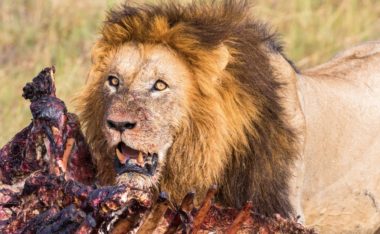
This is how long a lion can survive without food. In short: Up to 1 month. So if you want to know all the details about how long a lion can live without food, then this article is for you. Let’s jump right in!  Food: A Basic Necessity of Life One of the basic necessities of life is food. Food is a source of energy that is required for all day-to-day activities.  As a person or animal takes in food, it is digested by the body so that the digested material can be absorbed and utilize by the cells in the body.  Waste material is removed through a process called excretion. Lion, the King of the Jungle: Current Situation Lions (Panthera leo) are one among many big cat species of the world. A lion, being an apex predator, can consume many different types of prey animals.  Lions will try to attack any other living creature courageous enough to come in front of them. Many will also be eaten, but not all.   Although hunting lions is banned globally, illegal hunting and habitat destruction has reduced the world lion population to just 20,000.  The Asiatic lions are slightly smaller than the African lions, and some differences are also present in their life cycles. To avoid confusion, our discussion will focus mainly on African lions.  What Do Lions Eat?  The “kings of the jungle” have several animals at their disposal to eat. Even though their food options are quite diverse, they do prefer certain types of foods over others. While they might attack smaller creatures like birds, rodents, and snakes, they usually prefer medium to large-sized ungulates. The ungulates are the hooved animals and include gazelles, zebras, giraffes, and water buffalos.  They can also hunt bigger animals such as a rhinoceros or an elephant, but they mostly target young ones or the weak and elderly of these giants.  Desperate situations can force the lions to resort to consuming the carcasses of dead animals and even stealing prey from other hunters such as leopards and hyenas.  What’s Their Preferred Food? Although lions might hunt and kill the animals even when not hungry, usually, they won’t expend energy that way. They want to use it to get their favorite foods instead, especially zebras. How Much Can a Lion Eat? The active lifestyle and royal habits require them to eat a lot. They can consume as much as 15% of their body weight in a single meal.  Studies on wild lions have shown that they can eat about 10-25 pounds (4.5-11.3 kg.) of food daily. The male lions require considerably more food, about 15 pounds (7 kg.), compared to their female counterparts, eating around 9.9 pounds (4.5 kg).  Captive lions eat less as compared to animals out in the wild.  Feeding Behavior of Lions Being obligate carnivores, meaning they can’t digest vegetation, these apex predators have to eat flesh to survive. Their social organization into prides gives them an additional advantage to hunt very large animals, such as elephants.  Hunting activities are usually done at dawn and dusk. Although lions prefer to stalk, sometimes they will also ambush prey. Commonly, a lion hunts about every 2-3 days.  Females Are More Successful Hunters In human stories, the kings go out hunting while the queens remain in the palaces. This is not the case with lions. Within the pride, the females that do most of the hunting because the highly prominent manes of the males make hiding very difficult.  Although the females will kill the prey, the Alpha male (the topmost male in the pride) is first served because of their primary role in protecting the pride from external threats.  Food Availability in the Wild Nature is simple but ruthless. Food availability for a lion depends directly on its hunting success rate, which usually doesn’t exceed 30%. The success rate itself is dependent on various factors such as health, age, and the types of food available.  You may be amazed to know that the lions are poor hunters as compared to other big cats. They are slower when compared to most other big cats, especially the cheetah, which is the fastest cat. A lion’s top speed usually does not exceed 50 mph (80 kph).  What Happens If Prey Is Scarce? Can you imagine a king succumbing to starvation? It’s hard to imagine, but it can happen to any creature.  A shortage of food may elicit the survival of the fittest response for most animal species. The older animals may be left to live on their own.  Such animals can’t hunt or forage for food, and no other animal may be willing to offer food. Such animals may become emaciated and will starve to death.  While this scenario may not play out within a pride of lions, since older animals usually died before they make it old age, it can happen. However, all lives within the pride are at risk if prey becomes scarce.   How Long Can a Baby Lion Live Without Food? A newborn cub feeds many times a day. Cubs can survive at least a full day without being nursed by their mother. This ability is advantageous because a lioness has to deliver and raise the cubs outside of the pack for three months. She also has to go out on hunting trips. The shortage of food does not threaten the survival of cubs for a short period of time. The greater threat is other predators such as hyenas.  Out in the wild, only 80% of the cubs are fortunate enough to reach their second birthday. In an overly large pride, the younger members have a greater chance of starvation in times of food shortages.  How Long Can Lions Go Without Drinking Water Do the lions quench their thirst with the blood of prey? This is an interesting question. The reality is yes, in many cases, they do.  In contrast to humans, lions can survive an exceptionally long-time during the absence of drinkable water. This may seem amazing, but it is not so surprising when you …

Read more

10 Fascinating Plack Era Facts.

10 Fascinating Facts About the Planck Era

These are 10 fascinating facts about the Planck Era. From time so small a human can’t understand it to temperatures millions hotter than the sun. So if you want the facts, then you’re at the right place. Let’s jump right in! #1 Pressure During the Planck Era Was Staggering If you’ve been underwater in the deep end of a pool, you understand the feeling of pressure. Not pleasant!  But, during the Planck Era, pressures were literally quintillions of times the pool pressures, you know.  After all, the entire universe was jammed into a microscopic speck. #2 Microscopic Timeline Indeed, the Planck Era only occurred briefly after the big bang began.  But, how briefly?  Actually, it was less than one quattuordecillionth of a second.  So, how brief is that?  In fact, it’s a “1” followed by 45 zeros.  In other words, too brief for humans to understand. #3 A Tiny Baby Universe Naturally, when the Planck Era was happening, the universe had barely grown.  Actually, at this time, the entire universe was smaller than a single atom. #4 Nice and toasty Because the entire universe was crammed into a microscopic dot, the pressure generated tremendous heat.  In fact, temperatures swelled to around 18-decillion degrees.  In other words, the core of our Sun multiplied by millions. Yeah, that’s hot. #5 Light Was Not Even a “Thing” Yet At the present time, the concept of “light” was not yet in existence.  Fundamental particles, like protons, were unable to bind together under such heat and pressure.  Therefore, the electron’s light-creating process was not yet a possibility. #6 Trust Me, You Wouldn’t Understand During the Planck Era, modern science and math do not make sense.  In fact, all human understanding of the universe is meaningless.  Simply put, the chaos and quantum weirdness taking place during this epoch are not things we have discovered nor understood yet.  Instead, all information we currently have of the Planck Era is purely speculation. #7 We Will Never See the Planck Era All astronomy relies on human’s ability to see or detect light.  The radiation allowed the discovery of every star, planet, and galaxy.  Therefore, without the existence of light during this epoch, modern science could never possibly “see” the Planck Era. #8 Fundamental Forces, Unite In high school science, we all learned of the four fundamental forces in the universe: Gravity  Electromagnetism  Weak  Strong nuclear force Not to mention, these four forces still appear independently everywhere around us today.  However, during the Planck Era, it is thought that all four forces were one single force. This would have been a perfect symmetry of the entire universe.  Often, science compares this to a pencil that stood on its nose, much too perfect to ever be stable. #9 Meaningful Times Mentioned above, during the Planck Era, our universe was in its infancy.  However, this unimaginably small timeframe serves a specific reason.  10^43 seconds, also known as a “Planck Unit,” is the shortest amount of “meaningful” time to humans and science.  Therefore, anything occurring during times shorter than a Planck Unit remains unable to be understood by us.  Hence, this mysterious and brief universal epoch. #10 Transient Particles Temperatures were so extreme during the Planck Era. Even fundamental particles could barely handle it.  Under such heat and pressure, protons could not bind. Nor could electrons could not orbit protons.  As a result, single particles bounced wildly throughout the universe, smashing into one another.  Plus, this meant that not a single atom existed yet in our universe.  Discover What the Planck Era Was Like Want to learn more about the Planck Era? Travel back in time and experience the Plank Era: Epochs of the Universe: Planck Era.

10 Fascinating Big Bang Facts (You Don’t Know These).

10 Fascinating Facts About the Big Bang

Here are 10 big bang facts. You probably don’t know these facts. Learn why the name big bang was an accident and why Einstein wasn’t a fan at first. Let’s get started! #1 A Mislabeled Event Typically, we picture the big bang as a sudden explosion, giving birth to an entire universe.  And, rightfully so, given its world-renown name.  However, the big “bang” was not believed to be an actual “bang” at all.  Rather, a moment in time in which everything appeared from nothing.  Therefore, a more accurate title may be the “big emergence?” #2 An accidental name Ironically, English astronomer, Fred Hoyle first coined the term “big bang” as a mockery.  Originally, upon learning of the newly-formed theory of an expanding universe, Hoyle showed his contempt and disbelief by jokingly labeling it the “Big Bang Theory.”  Ultimately, the title caught on. #3 Where Did the Big Bang happen? Often, people wonder where the big bang took place.  After all, we do see objects occurring at specific places and times in space.  However, the big bang happened everywhere all at once. Indeed, this is tough to wrap a human mind around.  But, often, science compares this concept to a balloon being inflated.  Equally, the universe expanded in every direction at once. Therefore, it is impossible to draw a line formally tracing back to a definite point in space.  It is space. #4 Everything from nothing Another unfathomable concept regarding the universe is that it came from nothing.  In physics, a singularity is an infinitely small space.  Furthermore, within this small space exists infinite gravity and density.  In fact, gravity within a singularity is so great that even light is unable to escape. As a result, pure darkness ensues.  Actually, black holes are also believed to contain a singularity. #5 Are we inside of a black hole? As mentioned previously (Where Did the Big Bang happen?), black holes also contain singularities.  Therefore, many current theories believe our universe is inside of a black hole.  Not to mention, some theories even provide a fairly concrete mathematical proof of such concepts. #6 The Hottest Time in History Occurring within a singularity, the big bang was the ultimate extreme. Simply put, the entire universe was jammed into an infinitely small space. In turn, this gave way to infinite temperatures—literally, temperature in which no numeric value can describe.  In fact, the same can be said for density, pressure, and most other universal measurements. #7 When did the big bang happen? Currently, science dates the big bang at slightly over 13.7 billion years ago.  First of all, it’s impossible to trace back to a single place where the big bang occurred because the universe has no center or edge.  Instead, every piece of the universe is constantly expanding, even today.  However, scientifically rewinding time does reveal when everything would have been crammed together in a singularity. #8 Life before the big bang Indeed, science and astronomy consider the big bang the start and creation of everything.  However, without light, humans are unable to observe this moment. Therefore, even many astronomers acknowledge that there may have been more that happened before the big bang.  Whether we will ever see or know this remains unknown. #9 You Can Watch the Real Big Bang on TV (No, Not the Sitcom) Blanketing the sky, the Cosmic Microwave Background Radiation (CMB) is the actual leftover radiation from the big bang.  As the universe’s first radiation occurred 380,000 years after the big bang, its thermal proof remained frozen in time.  No matter which direction you observe, our human limits reach this wall of energy. Because of this, when analog TVs (using antennae) flicker with static, a smaller percentage is due to the CMB.  However, only around 1% is from the big bang.  Nevertheless, still pretty cool. #10 Einstein Was NOT a Fan, at First! In 1927, Belgian priest Georges Lemaître proposed the idea that our universe could be expanding.  And, this concept also meant that the universe could have been dramatically smaller in the past.  Lemaître wrote to Einstein, sharing the exciting information. In his reply, Einstein remarked, “your calculations are correct, but your physics is abominable!”

15 Unsolved Space Mysteries (+ Interesting Facts)

15 Unsolved Space Mysteries

These are 15 unsolved space mysteries. From what white holes are to how life began. So if you want to learn 15 unsolved mysteries of our universe, then this article is for you. Let’s get right into it! 15 Unsolved Mysteries of Our Universe Even with all of the incredible technology at our disposal today, the universe is a complex and largely unknown realm. Armed with far more questions than answers, science constantly battles to understand more about the existence of it all.  These are 15 of the least-understood, most mind-boggling, and bazaar unsolved space mysteries: #1 Why Is Uranus Tilted? First of all, we were unable to find a not awkward way to draft this title.  There, we said it. Now, one of the great unsolved space mysteries is right in our own cosmic backyard.  Planet Uranus is extremely tilted on its axis. Sure, all planets have some axial tilting.  For instance, Earth is tilted 23.5º away from the Sun. But, Uranus is tremendously tilted, at just shy of 98º. Science has yet to explain this tilt accurately, but we do know that it must have been the result of a brutal collision.  And, this collision must have occurred when Uranus was still a baby.  We know this because the planets Moons also orbit around this tilted plane, hinting that the collision happened prior to the satellites coalescing into existence. #2 Why Is the Sun’s Corona so Hot? Similar to Earth, the Sun has an atmosphere.  However, the Sun’s atmosphere is much hotter by factors of thousands.  The biggest layer of the Sun’s atmosphere is called the Corona. One of the biggest unsolved space mysteries is why the Corona is so much hotter than the Sun’s surface below.  And, it’s not just a little warmer. It’s hundreds of times more scorching at millions of degrees Fahrenheit.  This would be like the air surrounding a campfire being hundreds of times hotter than the actual flames of the fire. #3 How Do Supernovas Happen? When a star runs out of its nuclear fuel, its own strong gravity wins, and the star collapses on itself.  The result of this is a violent explosion known as a supernova.  Now, in modern science, we know a rather healthy amount about these blasts.  But, our current technology does not allow us to see the insides of stars.  Because of this lack of insight, what occurs inside of a star as a supernova takes place is one of the currently unsolved space mysteries. #4 How Do “Hot Jupiters” Get so Close to Their Stars? Hot Jupiters are an exotic class of large exoplanets, similar in size and composition to our giant, Jupiter.  Yet, they remain one of the great unsolved space mysteries because they orbit remarkably close to their Sun. Planets of this gaseous composition are unable to form so close to a star.  So, what caused these mysterious giants to cuddle up?  Though we still do not know for sure, astronomers believe some type of collision knocks the planets into irregular orbits, like comets.  Eventually, the star’s powerful gravity may lasso the planets into a tight, searing, and deadly orbit. #5 What Causes Jupiter’s Great Red Spot? Arguably, Jupiter’s most notable feature is also one of the biggest unsolved space mysteries.  The planet’s infamous great red spot is a chaotic, swirling hurricane-like storm.  Big enough to house over three Earths, the storm has been raging on for at least 400 years now.  Although scientists know some storm characteristics, they have little to no explanation for its causes, let alone how it has been churning for so long now.  Plus, our study time is slowly running out, as we know that the storm is gradually shrinking. #6 What Are White Holes, and Are They Real? Among Einstein’s litany of staggeringly brilliant predictions are what is referred to as a white hole.  The mathematics of his renowned Theory of General Relativity state that the polar opposite of a black hole must exist.  In other words, these are regions of space where infinite amounts of mass burst out from points of seemingly nothing. Now, modern technology has allowed us to confirm the existence of black holes, including at the heart of our own galaxy.  However, white holes remain an unsolved space mystery because, well …where are they?  Yet, the hunt continues, if nothing else, because Einstein was rarely proven wrong, even long after his death.  After all, we just confirmed gravitational waves 100 years after he predicted them. #7 Are There Multiple Universes? The concept of the multiverse has been the plotline of countless sci-fi flicks.  And, while it’s fabulous film and literature fodder, it’s also one of the biggest unsolved space mysteries.  No surprise, the internet is riddled with potential theories, scientific and far-fetched alike. Yet, science can barely wager a guess at whether or not this may be true.  After all, we have hardly even broken the ice with figuring out our own solar system, let alone space on the universal scale.  However, we know for sure that we exist in a likely infinite world, and multiple universes are anything but written off. #8 How Are Galaxies Formed? Scientists now have some ideas as to how planets, stars, and several other astronomical objects are formed.  Yet, one of the most sought-after and yet unsolved space mysteries is how galaxies are formed. It coalesced to form these large whirling collections of stars, solar systems, dust, and more in the early universe when matter came to be.  But, even though there are thought to be hundreds of billions of galaxies, science has no answer for how they were created. #9 If the Universe Is Infinite, Then Were Is Everybody Else? Basically, just our own galaxy contains around 400 billion stars.  Supposedly, around 20 billion of those are stars similar to our own Sun.  Now, it is thought confidently that 1/5 of these Sun-like stars have an Earth-like planet in their habitable zone.  Therefore, if even just 0.1% of these planets harbor life, our galaxy alone would have 1 billion …

Read more

10 Weirdest Planets in Our Universe.

10 Weirdest Planets in Our Universe

These are the 10 weirdest planets in our universe. From the water world GJ 1214 b the diamond world 55 Cancri e. So if you want to learn about the strangest planets in our universe, then you’re in the right place. Let’s jump right in! 10 Weirdest Planets No doubt, our universe is loaded with bazaar and mysterious places and things.  Like NASA’s Kepler telescope, modern technologies have allowed us to scan the heavens for other planets.  Now, with thousands confirmed, there are officially some weird planets.  But, as with anything in astronomy, new, even more, odd planets will inevitably be found.  But, as of now, here are the 10 weirdest planets in the universe: #1 GJ 1214 b – Water World Unlike the disappointing 1995 box office bomb, GJ 1214 b is a planet believed to be covered completely by one gigantic ocean.  And, these vast waters would allow depths thousands of times deeper than our largest Earth oceans.  Now, depending on temperatures and conditions, the waters’ phases may exist in steam, ice, plasma, and more. Therefore, not only is GJ 1214 b one of the weirdest planets, but it’s also one of the most promising.  After all, where there is water, there is oxygen, and where there is oxygen, there may be life. #2 CoKu Tau 4 – Baby World At less than 1 million years old, an unnamed planet orbits a star known as CoKu Tau 4.  Seems normal, right?  It has long been thought that planets take several million years to form.  Plus, planets form out of discs of dust and gas long after their parent stars have formed.  So, not only is CoKu Tau 4 one of the weirdest planets, it is currently making astronomers rethink their planetary formation theories. #3 Kepler-37b – Tiny World As of 2013, Kepler-37b is the smallest known exoplanet (a planet outside our solar system).  Only slightly larger in size than our Moon, this planet orbits close to its star. Because of this, its surface temperatures are thought to be around 800º F, hot enough to melt lead.  So, Kepler-37b may not necessarily be one of the weirdest planets, but it sure is the smallest. #4 GJ 504b – Pink World Around 57 light-years away is the exoplanet, GJ 504b, a planet about the same size as Jupiter.  This large planet has a deep magenta color, but that is not what makes GJ 504b one of the weirdest planets.  Planets the size of Jupiter are rather common in our galaxy.  But, they can only form within a certain distance from their star.  Simply put, anywhere father out from the star than Neptune does not have enough debris to form a planet this large eventually. However, GJ 504b sits nearly 44 times farther from its star than Earth from the Sun.  In our own solar system, this would be like Jupiter orbiting drastically far beyond Neptune. Because of this, astronomers now have to rethink modern theories of planet formation. #5 WASP-12b – Hot World WASP-12b is one of the weirdest planets simply because of its tremendous heat.  At twice the size of Jupiter, this planet is believed to reach sweltering temperatures of 4,000º F.  These extreme temperatures are hot enough to melt titanium, steel, platinum, nickel, and iron.  In other words, not suitable for life. #6 TrES-4 – Giant World TrES-4 is an absolute giant planet, ringing in at over 70% larger than Jupiter.  But its behemoth size is not what makes this one of the weirdest planets.  Despite its size, the planet only contains 75% of Jupiter’s mass. This means that the giant planet has a density similar to cork or balsa wood.  Obviously, this has astronomers a bit puzzled. #7 Methuselah – Ancient World Named after the long-lived biblical character, this strange planet is thought to be around 13 billion years old.  But it’s not the age that makes this one of the weirdest planets.  Rather, the fact that this Jupiter-sized world could even exist during this time period is vexing.  It was believed that in this infant universe, planet-forming materials did not yet exist. Apparently, this was incorrect. #8 PSR J1719-14 b – Speed World PSR J1719-14 b is another potential candidate for diamond planets (see #1).  But, what makes it one of the weirdest planets is its speed, orbiting its star in only 2.2 hours.  In other words, if you were celebrating your 21st birthday, you would actually be turning 83,000 years old. Shots! Also, the planet orbits a pulsar, which is a very dense, rapidly-spinning star leftover from a star’s violent death.  So, technically three things make PSR J1719-14 b one of the weirdest planets. #9 TrES-2b – Dark World This ominous planet only reflects 1% of the light that hits it, hence the name dark world.  This small amount of reflection would make it appear darker than black matte acrylic paint.  It is thought that TrES-2b may have no reflective clouds because of its high temperature.  Or, it may be because the planet contains chemicals that absorb light.  Finally, scientists say it may be possible that it contains chemicals that we have not yet discovered. #10 55 Cancri e – Diamond World In the constellation Cancer, super-Earth-sized planet 55 Cancri e is believed to contain an abundance of carbon.  Under tremendous pressures and temperatures orbiting close to its star, the carbon turns to diamond.  Hypothetically, this glitzy world was valued at $27 nonillion (that’s 27 followed by 30 zeros).  That would be over 300 quadrillion times planet Earth’s total GDP of $70 trillion.

Quasars for Dummies: What Is the Meaning of Quasars?

Quasars for Dummies: What Is the Meaning of Quasars?

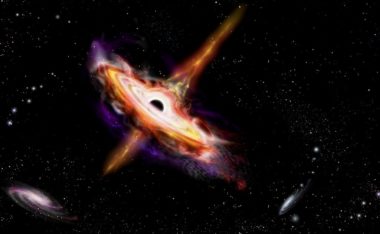
This is about quasars. Quasars show up differently from different angles. So if you want to know what a quasar is put simply, then you’ve come to the right place. Let’s get started! What Are Quasars? During the 1960s, the dawn of radio astronomy unveiled a wealth of exciting new mysteries.  Signals revealed the cosmic microwave background, pulsars, and more.  Eventually, over time evidence told a full story, and we learned something new about our universe.  Among the greatest radio signal mysteries of the decade: quasars. Let’s break these distant cosmic mysteries down and get quasars explained! Searching for Answers Short for quasi-stellar objects, quasars first appeared as small and extremely bright objects. Not to mention, some were found to be moving away from Earth at a third of the speed of light (around 22 million mph). For years, astronomers quarreled over the cause of these supposedly speedy bright objects.  From advanced alien civilizations to incorrect measurements of the universe’s expansion, explanations ran the gamut. Later, in the 1980s, astronomers began agreeing on the active galaxy theory. This idea stated that some unknown processes caused certain galaxies to blast massive amounts of energy from their cores. Active Galaxies Now, confident in the active galaxy theory, astronomers wanted to know the cause.  Why was extreme energy blasting out of some galaxy’s centers? Today, we know that nearly all galaxies have massive, dense black holes at their centers.  And, as matter nears the black hole, it is heated to millions of degrees, and enormous amounts of energy are emitted as a result.  Furthermore, the strong magnetic poles of the black hole create jet-like streams of energy. This energetic center is known as the active galactic nucleus (AGN). Different Perspectives When a neutron star’s energy jets point directly at Earth, we call it a pulsar.  Otherwise, all characteristics of neutron stars and pulsars are identical. Similarly, quasars yield different results when viewed from various angles. When a quasar’s jets are perpendicular to us, we know it as a radio galaxy. Next, quasars seen from angles are simply called quasars. Finally, blazars have quasar jets pointed directly at Earth. Feeding Times As mentioned above, the beaming jets of a quasar result from material getting near a black hole.  At this point, a black hole essentially “feeds” on cosmic material.  And, as the matter approaches the black hole, an accretion disc is formed around the hole’s “surface” (the event horizon).  Now, the material in the disc is heated to staggering multi-million-degree temperatures.  As a result, excess energy is released, blasting out in the twin jets of a quasar. However, the material is not always approaching a black hole.  There are periods of time in which little or no material is nearby. Now, without energy production, quasar jets shut down. Hence, many astronomers jokingly refer to this process as a black hole’s “burp.” Are We an Active Galaxy? Now, we know that nearly all galaxies have black holes at their centers.  Also, we know that our own Milky Way galaxy, indeed, has a massive black hole named Sagittarius A*. So then, why does the Milky Way not have a quasar shooting out? Well, as mentioned above, quasars’ massive energy results from a black hole “feeding” on the material.  Right now, our home black hole does not have food to eat. Therefore, the nucleus of the Milky Way is not currently active. However, many astronomers believe that our galaxy was, at one time, an active galaxy with bright jets blazing out.  Also, some believe that we will again become an active galaxy in the distant future. In billions of years, our Milky Way will collide with the massive neighboring galaxy, Andromeda.  And, as you might imagine, with the gargantuan amount of matter in both galaxies colliding will yield dramatic results.  New matter flung toward our center will activate our black hole, and it again becomes a bright quasar!